Every soccer parent has been there — wondering why kids stand around in soccer games instead of chasing the action. Your kid is standing 10 yards away, staring into the distance like they’re admiring the clouds. You’re gripping the sideline fence. You want to scream. Sound familiar?
Before you do — take a breath. There’s actually a really good reason this happens, and understanding it will change how you watch every game from here on out.
Why Kids Stand Around In Soccer Games – It’s Not Laziness. It’s Brain Development.
Here’s the thing most parents don’t know: young kids are neurologically incapable of understanding movement off the ball.
According to youth soccer development research, children under 7 are still forming the basic cognitive wiring needed to process a fast-moving, multi-person environment. They can see the ball. They cannot yet see the game.
Think about what soccer actually demands: you have to track the ball, know where your teammates are, anticipate where the ball is going, and move to a space that doesn’t exist yet — all at the same time.
That’s incredibly advanced thinking. Most kids under 10 are still working on it.
The “Swarm” Problem (AKA Why 10 Kids Chase One Ball)
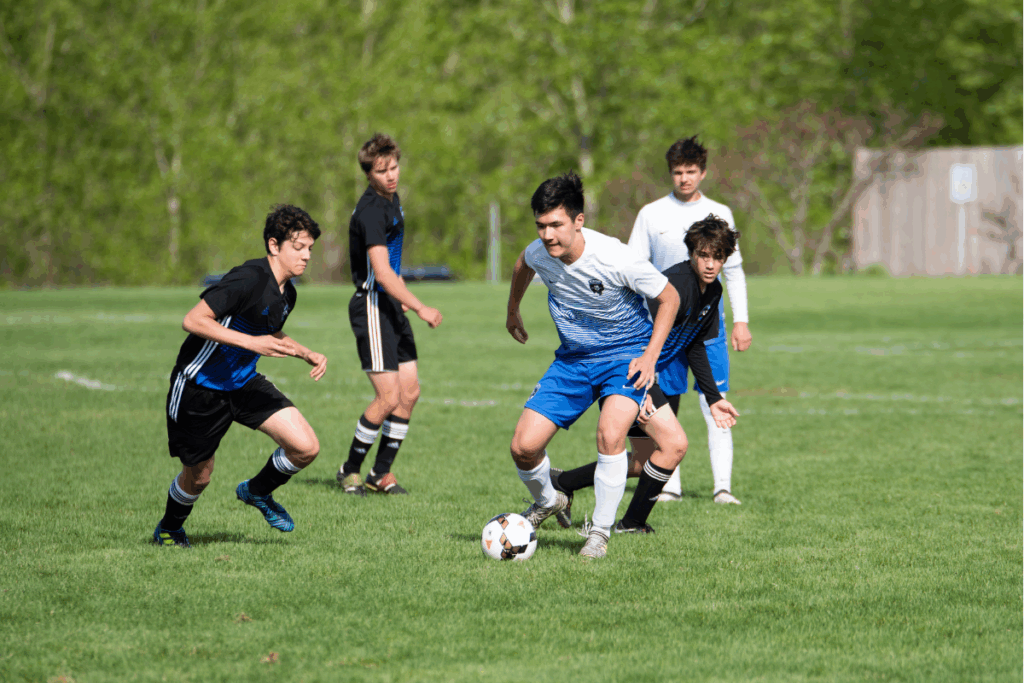
Ever watch a U6 or U8 game and see the entire team bunched around the ball like a mob?
That’s called the swarm effect, and it’s completely normal.
Young players are egocentric by developmental design — they don’t naturally think about teammates or open space. Most players under six won’t quite understand the concept of teamwork. They get excited when they have the ball to themselves and won’t really consider passing it off to anyone else.
This isn’t a character flaw. It’s just where their brains are at.
So Why Do Kids Stand Around Away from the Ball?
Once kids get a bit older (U8–U12), the swarm starts to break apart — but a new problem emerges: kids who don’t know where to go stand still.
Here’s what’s happening in their heads:
- They don’t know where to move — No one has taught them why to move to certain spaces, so they freeze.
- They’re afraid to mess up — Kids who are anxious about making mistakes often go inactive rather than risk doing something wrong.
- They’re waiting to be told — Many kids have been coached to follow instructions. When no instruction comes, they wait.
- The game is too big for them — A full-sided 11v11 game is often beyond the comprehension of a nine-year-old. Playing and understanding the game are completely different things.
What “Movement Off the Ball” Actually Means — And Why It’s Hard
“Move to open space!” sounds simple from the sideline. On the field, it’s anything but.
To move effectively without the ball, a child must:
- Know where their teammates are
- Know where defenders are
- Identify an open lane with no one in between
- Get there before defenders close it
- Signal they’re ready for a pass
Teaching movement off the ball requires stopping the action, pointing out good places to move to, and demonstrating why — it’s a mental skill, not a physical one.
Your kid isn’t going to figure that out by instinct. It has to be taught — repeatedly.
The Age-by-Age Reality Check
| Age | What’s Normal |
|---|---|
| U6 | Ball-chasing mobs. Everyone wants the ball. No one passes willingly. |
| U8 | Some kids start hanging back, but they don’t know why or where to go. |
| U10 | Players start grasping positioning, but decision-making under pressure is still developing. |
| U12+ | Movement and awareness start to click — but it takes consistent coaching to get there. |
What Can You Actually Do as a Parent?
On the sideline: less is more.
Yelling “Shoot it!” or “Pass it!” from the sideline can cause anxiety for a player already under pressure on the field — and may directly contradict what their coach has instructed them to do.
Stick to cheering. Let the coach coach.
At home:
- Watch soccer with your kid and ask “where would you go if you were that player?”
- Play small pickup games — even 2v2 in the backyard teaches spatial thinking faster than any drill
- Celebrate effort and movement, not just goals
Mindset shift: Your kid standing still isn’t failing. They’re in the middle of learning one of the hardest cognitive skills in team sports. Give them time.
The Bottom Line
When you see your kid standing around during a soccer game, you’re not watching laziness — you’re watching a developing brain working in real time.
The kids who eventually become great players aren’t the ones who were naturally brilliant at 8. They’re the ones whose parents cheered from the sideline, let them make mistakes, and gave them the gift of time.
So next time you ask why kids stand around in soccer games and your kid stares into the distance while the ball rolls past them?
Clap. Smile. And trust the process. ⚽
If this helped you make sense of what you’re seeing on the sideline, share it with every soccer parent you know — especially the ones gripping the fence a little too tight.
And if your child is still figuring out where they even belong on the field, our guide to Youth Soccer Positions Explained for Parents breaks it all down in plain language. Understanding their role is the first step to understanding their movement.
You might also want to check out Kids Playing Multiple Sports: 5 Things Parents Must Know — because the best thing you can do for a young soccer player’s development might have nothing to do with soccer at all.